Productscpzx

1. Product Introduction
PU machined parts take polyurethane (PU) as the base material. Fillers such as PTFE and molybdenum disulfide can be added for modification. Billets including PU sheets, rods and tubes are produced by casting or extrusion, and then finished into special-shaped wear-resistant components via CNC turning, milling, grinding and other precision machining processes.
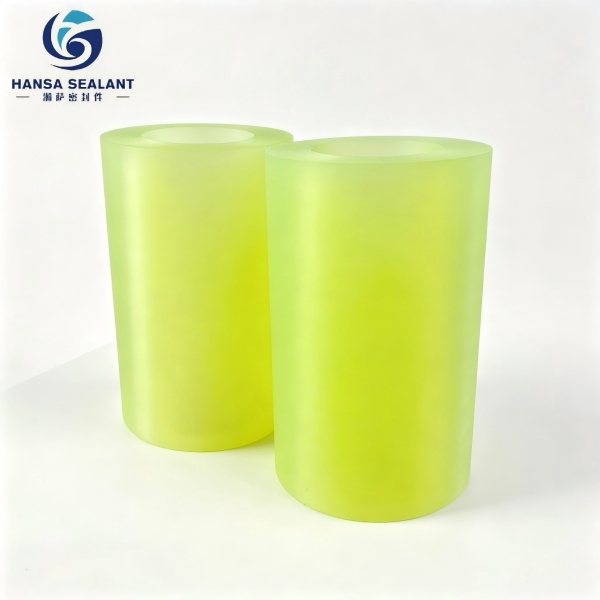
Our flagship grade is 80% PU + 20% PTFE. Its dimension: ID 76.2 mm × OD 127 mm × Length 206.375 mm.
We can custom-make bushes, pistons, guide rings, spacers, rollers and other non-standard parts according to customers’ drawings or samples. These products combine elasticity, load-bearing capacity and self-lubricating performance, and are widely used as substitutes for metal, ordinary rubber and pure PTFE components under sliding friction conditions.
2. Physical & Chemical Properties
Item
Specification & Description
Material Composition
Polyurethane base, modifiable with PTFE, MoS?, etc. Main formula: 80% PU + 20% PTFE
Coefficient of Friction
Low friction and self-lubricating; much lower than standard PU
Hardness Range
Shore A 60 ~ 95, adjustable on request
Continuous Operating Temperature
-40℃ ~ 100℃, short-term peak ≤120℃
Media Resistance
Resistant to hydraulic oil, lubricant, water, weak acid & alkali, common grease; Not resistant to concentrated strong acid/alkali and strong polar solvents (ketones, esters)
Mechanical Performance
High tensile strength, tear resistance and extrusion resistance; better anti-creep property than pure PTFE with high load capacity
Electrical Insulation
Good electrical insulation with high insulation resistance
Elasticity & Shock Absorption
Excellent elasticity for impact absorption, vibration and noise reduction
Wear Resistance
Modified formula delivers far longer service life than ordinary PU and rubber parts
3. Typical Application Fields
Application Sector
Applied Components
Function
Hydraulic Construction Machinery
Cylinder guide bushes, piston bushes, support rings
Positioning guidance, friction & wear reduction, protecting piston rods from scratching
Automation Equipment
Plain bearings, roller bushes, buffer blocks
Low-resistance sliding, vibration damping for stable reciprocating motion
Mining & Heavy Industry
Heavy-load sliding pads, wear-resistant sliding blocks
Withstand impact loads and resist abrasion in dusty environments
Automotive Industry
Hydraulic brake components, shock support parts
Shock buffering and wear resistance to improve system stability
Fluid Pumps & Valves
Pump liners, valve seat wear parts
Resist medium erosion and reduce abrasion at sealing positions
General Tooling
Locating blocks, anti-collision buffers
Protect workpieces and absorb impact force
4. Selection & Design Guide
| Material Formula | ID (mm) | OD (mm) | Length (mm) | Recommended Working Conditions |
| 80% PU + 20% PTFE | 76.2 | 127 | 206.375 | Medium & heavy-load hydraulic cylinders, large guide mechanisms requiring self-lubrication |
| Conventional cast PU | 20 | 40 | 50 | Light load, shock absorption, no continuous sliding friction |
| 85% PU + 15% PTFE | 30 | 60 | 80 | Small & medium-load air cylinders, bushes for automation modules |
| 75% PU + 25% MoS? | 50 | 90 | 100 | Low-speed heavy load, dusty conditions, priority for wear resistance |
Quick Selection Tips:
1. Self-lubrication and less oil supply required → Prioritize PU+PTFE modified grade (C24621 recommended)
2. Shock buffering only with minimal friction → Choose standard PU
3. Operating temperature over 100℃ or strong corrosive media → PU is not suitable; switch to PTFE / PEEK
4. Reserve proper fitting clearance in design to avoid jamming caused by thermal expansion; adopt thicker wall design for high-pressure scenarios
Please provide working pressure, moving speed, medium type, long-term operating temperature and installation space dimension for accurate selection.
5. Operation & Maintenance
5.1 Assembly: Do not scratch the working surface with sharp tools. Press-fit with dedicated tooling instead of forced knocking to prevent cracks and surface scratches which will accelerate wear sharply.
5.2 Condition Control: Keep continuous working temperature below 100℃. Avoid long-term immersion in strong polar solvents and concentrated acid/alkali.
5.3 Dust Protection: Install dust-proof structures for dusty applications to prevent hard particles from entering friction pairs and causing abrasive wear.
5.4 Lubrication: PU+PTFE grade is self-lubricating. Continuous oil supply is unnecessary under normal conditions; a small amount of lubricant can extend service life for high-speed applications.
5.5 Storage: Store at room temperature away from heat sources and UV exposure to prevent aging, hardening and elasticity loss of PU.
5.6 Periodic Inspection: Check inner bore wear regularly. Arrange replacement in advance to avoid sudden failure which may scratch metal host parts and reduce downtime losses.
6. Development Trend
6.1 Upgraded Modified Formulas: PU compounded with PTFE, aramid fiber and nano powder becomes mainstream. It further balances wear resistance, low friction and high-temperature resistance to break the temperature limitation of conventional PU.
6.2 Intelligent Precision Machining: Automated CNC machining is widely adopted. Tolerance and concentricity are continuously improved to meet high-precision assembly requirements of premium hydraulic and sophisticated equipment.
6.3 Eco-friendly Raw Materials: Low-VOC and bio-based polyurethane raw materials are gradually promoted to meet environmental compliance requirements for exports to the EU and other regions.
6.4 Integrated Composite Structure: PU parts bonded with metal inserts are increasingly popular, combining supporting and wear-resistant functions to simplify customer assembly.
6.5 Digitalized Selection: Wear databases are established based on pressure, speed and temperature parameters to realize service life prediction for customers.
7. Market Expansion
PU machined parts were traditionally used mainly in hydraulic engineering machinery. Their application scope is expanding rapidly:
? New Energy Industry: Wear-resistant supporting and buffer components for lithium battery equipment, suitable for clean oil-free working environments
? Rail Transit: Shock-absorbing wear-resistant pads and sliding support assemblies
? Marine Equipment: Wear-resistant parts for seawater hydraulic systems (compatible with seawater and emulsion media)
? Food & Pharmaceutical Machinery: Sanitary-grade wear-resistant polyurethane components
For foreign trade, hydraulic repair dealers and OEM equipment manufacturers show steady growing demand for PU+PTFE modified bushes, which have great potential to replace imported wear and sealing components.
8. Conclusion
PU machined parts feature excellent elasticity and load-bearing capacity of polyurethane. Modified with PTFE and other fillers, they achieve self-lubricating property and overcome the drawbacks of insufficient load capacity of rubber and creep deformation of pure PTFE.
Manufactured by casting billet production plus precision machining, they can flexibly fulfill non-standard customization requests for various sliding friction scenarios such as hydraulic, automation and mining industries. With the iteration of new material formulas and precision processing technology, modified PU machined parts keep moving toward higher precision, longer service life and wider industry coverage. Proper product selection together with standardized installation and maintenance can effectively cut friction loss and downtime, helping customers reduce overall operating costs.