Productscpzx

1. Product Introduction and Main Production Methods
1.1 Product Definition
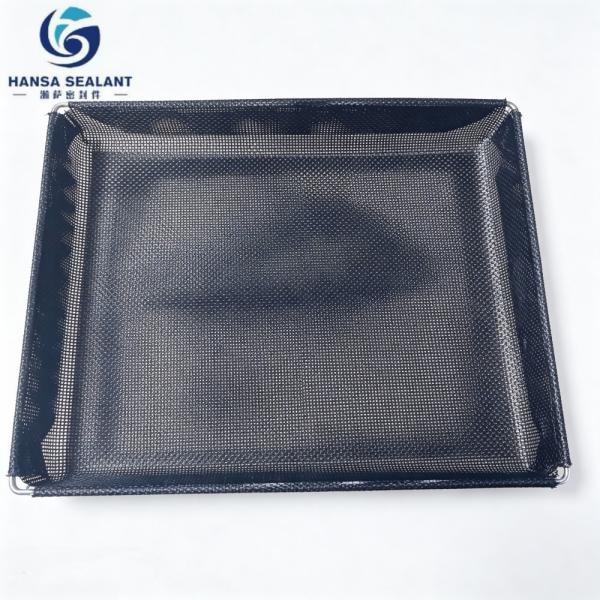
The PTFE mesh baking tray is a high?performance three?dimensional tray featuring high?strength E?Glass Mesh Fabric as the base skeleton material. It is manufactured via a unique impregnation and high?temperature sintering process with food?grade polytetrafluoroethylene (PTFE) resin compounded onto the substrate, combined with an internal reinforced metal frame and high?temperature?resistant edge?wrapping technology.
This product integrates the rigid three?dimensional load?bearing capacity of metal trays with the outstanding non?stick, temperature?resistant and air?permeable properties of PTFE materials. Its open?cell mesh structure enables 360?° all?round hot?air/gas circulation. While preventing materials from falling off and sticking, it greatly improves heat exchange and drying efficiency.
1.2 Main Production and Processing Flow
Base Fabric Weaving and Pre?treatment: E?glass fiber yarns are precisely woven into warp?weft mesh fabric by multi?shaft shuttleless looms. The fabric undergoes high?temperature degreasing, setting and impurity removal to guarantee regular mesh openings and high tensile strength.
Multi?pass Impregnation and Constant?temperature Sintering: The glass?fiber mesh fabric is fed into an impregnation production line and soaked in food?grade PTFE emulsion. Repeated cycles of “impregnation?drying?high?temperature sintering (380℃~400℃)” are performed to allow PTFE resin to uniformly and densely coat glass?fiber filaments and achieve molecular?level firm bonding.
CNC Precision Cutting: Laser or CNC die?cutting machines cut the PTFE?coated mesh fabric to specified unfolded dimensions according to drawings, with dimensional tolerance controlled within ±1?mm.
Frame Forming and Edge?wrapping Pressing: 304/201 food?grade stainless?steel wire is cold?bent to form a supporting outer frame. High?density PTFE heat?resistant edge?wrapping tape is applied via mechanical chamfer cold extrusion or high?frequency heat?sealing to form a rigid three?dimensional structure.
Finished?product Full Inspection: 100?percent inspection covering dimensions, load?bearing capacity and coating flatness is implemented.
2. Physical and Chemical Properties.
Performance Dimension
Key Technical Indicators / Parameters
Physicochemical Mechanism and Performance
Temperature Resistance
Continuous operating temperature: ?70℃ to +260℃; short?term extreme temperature tolerance: +300℃
No embrittlement under cryogenic freezing (?70℃); no softening, decomposition, smoke or odor release under high?temperature baking conditions.
Non?stick Surface, Hydrophobicity and Oleophobicity
Dynamic friction coefficient: <0.05; critical surface tension: 18?mN/m
Extremely low surface energy renders wetting by other substances difficult. Release rate for grease, sugar residues, cheese and high?viscosity resin is nearly 100?%; oil brushing is unnecessary.
Chemical Corrosion Resistance
Resistance range: pH?0?14 for all media
Completely inert to strong acids, strong alkalis, organic solvents, heavy salt spray and strong oxidants; free of rust, blistering and harmful impurity leaching.
Air Permeability and Heat?exchange Efficiency
Mesh open?cell ratio: 50?%?75?%
360° three?dimensional hot?air convection with minimal resistance to hot?air penetration; hot?air utilization efficiency is improved by more than 25?% compared with solid metal trays.
Dielectric Properties and Microwave Transmittance
Dielectric constant: ≈2.0?2.2; dielectric loss tangent: 10??
100?% transmission of microwave and radio?frequency waves; no heat absorption, arcing or electromagnetic?wave attenuation in microwave drying and high?frequency heating equipment.
Mechanical Strength and Dimensional Stability
Warp?weft tensile strength: ≥1500?N/5?cm; thermal shrinkage: <0.1?%
Excellent dimensional stability in warp and weft directions under high?temperature and high?humidity working conditions; no deformation, collapse or warping under long?term 4?5?kg loads.
Food?safety and Biocompatibility
100?% PFOA?Free, BPA?Free; compliant with FDA?21?CFR?177.1550 / LFGB
Meets international food?contact and medical?grade hygiene standards; no volatile organic compound (VOC) or microplastic leaching at elevated temperatures.
3. Typical Application Fields
Industry
Specific Application Scenarios
Core Functions and Customer Value in Relevant Fields
Commercial Baking and Catering
Commercial convection ovens, air fryers, pizza chain ovens, roast?chicken / roast?meat processing
360° hot?air?circulation baking delivers crispy textures; grease drains smoothly for low?fat and low?oil cooking; eliminates sticking and scorching.
Food Dehydration and Agricultural Processing
Preserved fruits and dried fruits, meat jerky, dried aquatic products, dehydrated premium pet food
Open mesh holes accelerate moisture evaporation and greatly shorten dehydration?drying cycles; high?sugar / high?colloid materials release completely without mesh adhesion.
Pharmaceuticals and Biological Products
Drying of herbal?medicine slices, extract?granule drying, medical freeze?drying trays
Resistant to acid?base corrosion and prevents heavy?metal?ion leaching and contamination; withstands repeated steam?in?place (SIP) sterilization and clean?in?place (CIP) washing.
Electronics and New?energy Manufacturing
Lithium?battery?electrode?coating baking, PCB curing, cleaning and drying of electronic components
Withstands volatilization of strong NMP solvent; high?insulation and anti?static properties; no heat absorption or arcing during microwave drying and delivers high drying uniformity.
Composite?material and Aviation Industry
Hot?press curing and forming of carbon?fiber / glass?fiber prepregs
Serves as a high?temperature air?permeable release layer; prevents resin adhesion and penetration and yields clean cured surfaces free of residual?glue contamination.
Chemical, Rubber, Plastic and Textile Industries
Continuous vulcanization and shaping of rubber strips, drying of printed fabrics, drying of special resins
Supports and carries viscous raw rubber; resistant to chemical corrosion and high temperatures; avoids material?to?roll sticking and cross?contamination.
4. Selection and Design Guidelines
4.1 Standard Recommended Models and Dimension Reference Table
Standard Model No.
Overall Dimension (L×W×H)
Mesh Aperture
Recommended Maximum Load
Typical Applicable Equipment and Scenarios
PTFE?TY?2528
250×280×30?mm
4×4?mm
≤3.5?kg
Household / commercial air fryers, small convection ovens, crispy baking
PTFE?TY?3040
300×400×30?mm
4×4?mm
≤5.0?kg
Standard commercial convection ovens, pizza baking, meat grilling
PTFE?TY?3333
330×330×25?mm
2×2?mm
≤4.0?kg
Commercial fruit?dehydration machines, herbal?medicine and flower?tea drying, small?berry drying
PTFE?TY?4060
400×600×35?mm
4×4?mm
≤8.0?kg
Industrial tunnel ovens, large?scale meat?jerky dehydration lines, large food?processing plants
PTFE?TY?CUST
Custom?made per drawings
1×1~5×5?mm
Custom?specified
Special?purpose industrial tunnel furnaces, laboratory vacuum drying ovens, equipment with irregular inner chambers
4.2 Key Matching Points for Selection
Mesh?aperture Selection:
? 1×1?mm ~ 2×2?mm: Suitable for fine herbal?medicine pieces, sliced flower tea, micro?berries and small?hardware cleaning (prevents leakage of fine?particle materials).
? 4×4?mm (universal golden aperture): Suitable for most conventional baking, meat, French?fry and dried?fruit?dehydration applications (balances air?flow throughput and material support).
? 5×5?mm and above: Suitable for high?air?volume fast?drying production lines and smoking / roasting of large whole cuts of meat.
Structure and Border?form Selection:
? Reinforced 304 stainless?steel wire rim: For independent single?tray manual handling, high?load?bearing and frequent?transportation conditions.
? Lightweight heat?pressed stitched hemmed edge: For densely stacked multi?layer rack insertion, assembly?line slide?rail conveyance and lightweight?material applications.
5. Usage and Maintenance Guidelines
Temperature and Heat?source Control:
Do not place the tray directly above charcoal, gas open flames or other heat sources with local temperatures exceeding 350?℃; keep it within the indirect?heating zone.
During oven / furnace preheating, avoid long?term no?load dry burning above 250?℃ as far as possible.
Tool Selection for Operation:
Use silicone tongs, high?temperature?resistant PTFE scrapers or wooden tongs for material handling. Do not cut directly on the mesh surface with sharp metal blades or scrape with hard steel?wire brushes.
Cleaning and Maintenance:
Immerse the tray in warm water while it retains residual heat; oil and sugar residues rinse off within seconds with neutral detergent.
Fully compatible with commercial spray dishwashers. Do not use steel?wool pads or strongly abrasive cleaning powders.
Storage Specifications:
Store idle trays flat, rack?mounted or hung. For stacked storage, ensure no sharp hard?metal debris squeezes the tray surface. Proper care yields a service life of more than 1000 operating cycles.
6. Industrial?technology and Development Trends
Green and Environment?friendly Composite?material Development: Fully adopt fluorine?free / water?based environmentally?friendly additive production processes to completely eliminate short?chain PFAS?derived residues and comply with increasingly stringent global ecological?safety regulations.
High?thermal?conductivity and Anti?static Functional Modification: Dope PTFE coatings with ultrafine carbon nanotubes (CNT) or micron?scale graphene to develop new?generation trays featuring excellent anti?static performance (surface resistivity: 10??10??Ω) and high thermal conductivity, meeting drying requirements for high?end electronics and semiconductors.
Integrated?structure and Ultra?lightweight Design: Adopt all?composite heat?pressed edge?forming technology to replace conventional hand?spliced edge wrapping, improving mass?production consistency and dimensional accuracy.
7. Market?application Expansion
Prepared Foods and Industrial Central Kitchens: Serve as core drying carriers for industrial secondary crisping and oil?removal production lines for pre?cooked meat products and quick?frozen fried foods.
New?energy Batteries and Energy?storage Materials: Function as contamination?free chemical?resistant carriers in solid?electrolyte?film preparation and separator vacuum?drying procedures for novel all?solid?state batteries.
High?end Pet Food and Functional Freeze?dried Fresh Pet Food: Amid market growth for high?end freeze?dried / baked pet food, PTFE mesh trays have become a standard solution to solve sticking issues for high?protein fresh?meat baking.
8. Summary and Conclusion
The PTFE Teflon mesh baking tray combines the material advantages of “high?strength glass?fiber?mesh substrate + high?molecular?weight PTFE coating + reinforced metal frame”. It fundamentally addresses pain points of traditional baking trays under high?temperature baking and material?drying conditions: material adhesion and difficult demolding, uneven heating, troublesome grease removal, and susceptibility to collapse and warping. It also significantly boosts hot?air?utilization efficiency and cuts energy consumption and maintenance costs.
Supported by complete international food?safety certifications and flexible OEM / ODM customization capabilities, this product acts as an ideal engineering carrier and cost?effective solution spanning commercial cooking, agricultural?product deep processing, biomedicine and high?end advanced?manufacturing sectors.